


Everyone Knows Bajaj Finance’s Playbook. So Why Can’t Anyone Copy It?

By
Arihant Team
Everyone knows Bajaj Finance’s strategy, but very few have managed to recreate its success. The real advantage isn’t the loan product itself—it’s the ability to turn a single customer into a long-term, multi-product relationship. Years of customer data, strong distribution, and continuous cross-selling have created a powerful growth engine. Now, with AI enhancing underwriting, engagement, and operations, Bajaj Finance’s moat is becoming even harder to replicate.
In This Article
- Introduction
- Customer Engine Behind Bajaj Finance
- Technology Layer Behind Bajaj Finance Moat
- Tata Capital vs Bajaj Finance | 3 Metrics That Explain The Gap
- Investor Takeaway
Introduction
There is a strange reality in Indian financial services. Every major lender knows what Bajaj Finance is doing. Its products are visible, its strategy is discussed on earnings calls, and its investor presentations are public. The playbook is not hidden. Yet, after more than a decade, Bajaj Finance remains the company every NBFC is compared with.
That raises the real question. If everyone knows the formula, why has nobody been able to replicate the outcome?
In FY26, Bajaj Finance generated a return on assets of roughly 4.3 percent. For most readers, that may not sound extraordinary. But in lending, it is a very strong number. Many lenders spend years trying to consistently cross 2 percent RoA, while Bajaj Finance has operated well above that level while continuing to grow.
That combination is what investors are really paying for. But RoA is only the result. The more important question is what produces it.
Open a free account today
Invest in tomorrow with just one click
Customer Engine Behind Bajaj Finance
Think about a customer buying a television on EMI. For many lenders, the transaction ends once the loan is repaid. For Bajaj Finance, that customer becomes the starting point of a much longer relationship.
The company now has repayment history, spending behaviour, product preferences, and future opportunities to offer more products. A television loan can lead to a personal loan. A personal loan can lead to a credit card. The same customer may later buy insurance or place money in a fixed deposit.
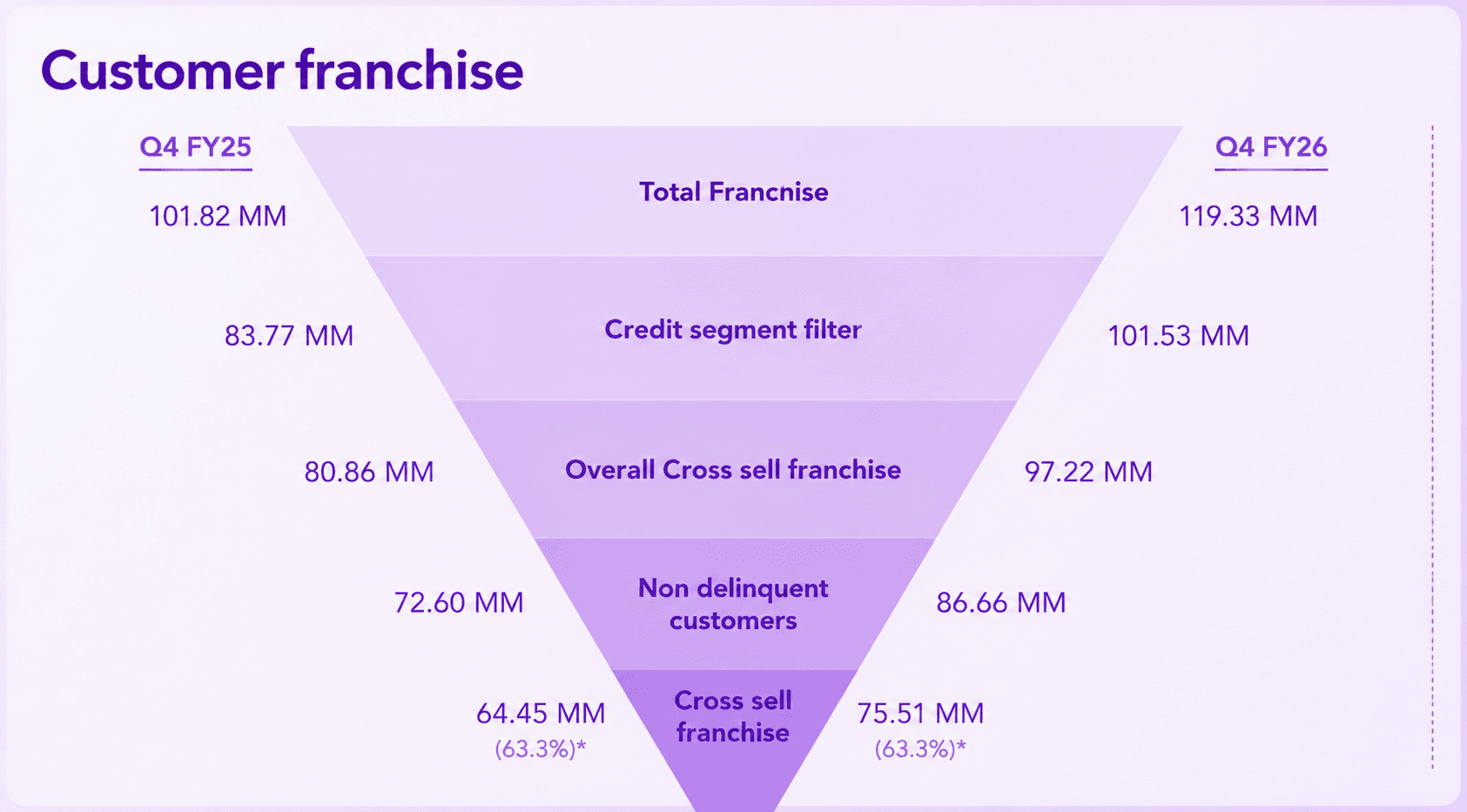
This changes the economics of the business. Acquiring a customer is expensive, but when one customer generates revenue across multiple products, the value of that relationship rises sharply. This is where many competitors struggle. They can acquire customers, but they have not been able to monetise those relationships with the same consistency.
Technology Layer Behind Bajaj Finance Moat
Bajaj Finance's moat is increasingly becoming technology driven.
For years, the company has built an advantage through customer acquisition, repayment data, and cross selling. Every new customer adds to a growing pool of information that helps improve underwriting, engagement, collections, and product recommendations.
AI is now accelerating this process. Management has disclosed that the company has already completed around 52 million voice to data conversions and 2.3 million text to data conversions. It is also using AI across marketing, customer onboarding, data extraction, and quality control to reduce manual effort and improve efficiency.
This is what makes the model difficult to replicate. Competitors can copy products and pricing. Replicating years of customer data, distribution reach, and an AI layer built on top of that data is far more challenging.
Tata Capital vs Bajaj Finance | 3 Metrics That Explain The Gap
Tata Capital's stock market journey shows exactly how investors think about the gap between potential and proven economics.
Tata Capital listed at ₹330 in October 2025 and later touched nearly ₹380. As of 24 June 2026, the stock was trading below that high, which suggests that investors like the story but are still waiting for more evidence.
To understand why, you need to look at the three metrics that actually drive NBFC valuations: Net Interest Margin, Return on Equity, and Return on Assets.
Net Interest Margin
NIM measures how much a lender earns on its loans relative to what it pays on its borrowings. It is the most direct indicator of pricing power and product mix.
Bajaj Finance runs a NIM of roughly 9.9%, driven by its dominance in high-yield consumer segments like EMI financing on electronics, personal loans, and co-branded credit products. Tata Capital's NIM is approximately 5.7%, reflecting a heavier mix of mortgages, LAP, and corporate lending.Return on Equity
RoE answers the most fundamental question in investing: how much profit does the business generate for every rupee of equity capital it holds?
Bajaj Finance delivered an annualised RoE of 20.0% in Q4 FY26. Tata Capital delivered an annualised RoE of 13.9% in Q4 FY26.
- Return on Assets
RoA is the most unforgiving metric in lending because it strips out the effect of leverage. Bajaj Finance's annualised RoA stood at 4.7% in Q4 FY26. Tata Capital's stood at 2.3% in the same quarter.
A gap of 240 basis points in RoA is enormous in lending. It means that for every ₹100 of assets deployed, Bajaj Finance generates ₹4.70 in profit while Tata Capital generates ₹2.30. That difference compounds directly into capital generation, which funds future growth without diluting existing shareholders. It is also what gives Bajaj Finance the freedom to invest aggressively in technology, distribution, and new product lines while still delivering strong returns.
Tata Capital's own three-year guidance targets an RoA of ~2.7% which would still be roughly half of where Bajaj Finance is today.
Investor Takeaway
The hard part for Tata Capital and every other NBFC competitor is that Bajaj Finance is not standing still. Its consolidated AUM crossed ₹5 lakh crore in FY26, adding scale that compounds into better data, better underwriting, and lower unit costs.
Every new customer, every additional EMI product cross-sold, and every improvement in collections efficiency widens the moat.
As a result, competitors are not chasing the Bajaj Finance of 2015. They are chasing the Bajaj Finance of 2026, a company with two decades of institutional learning in consumer credit. That is a fundamentally harder task and the metrics make clear exactly how wide the road still is.
Related Topics


Beyond the Dark Store: Is Advertising Zepto's Real Business?


NSE Extends F&O Market Close to 3:40 PM: What Traders Must Know

Elon Musk’s $119 Billion Terafab Bet: Can It Reshape AI Chips?

Rupee Crashes to ₹96: How Investors Can Profit From the Fall

The Rise of India’s Defence Sector: Stocks, Trends & Opportunities

SEBI introduces Verified Badge for Trading Apps to Curb Fake App Scams

TCS Q4 Concall: AI Infrastructure to Drive the Next Growth Cycle


Oil Is Surging After The Iran Strikes. So Why Isn’t Gold Following?



Union Budget Day & Market Behaviour: 15 Year Trend Analysis (2011-2025)

Infosys ₹18,000 Crore Share Buyback: Record Date & Why Promoters Opted Out?

Nifty 50 Performance Since Last Muhurat Trading: Nifty Top 10 Performers

Diwali Muhurat Trading: Can Nifty’s 7-Year Winning Streak Continue?


Tata Motors Demerger Gets NCLT Nod: What Shareholders Must Know

Muhurat Trading 2025 on 21 Oct: Everything You Should Know



Tuesday is the New Thursday: NSE & BSE Expiry Shift from Sep 2025


Axis Bank Q1FY26 Results: A Mixed Bag, but Long-Term Picture Still Intact