
Tech Mahindra Announces 1:1 Bonus Shares: Q2FY27 Profit Jumps 33%
Tech Mahindra gave shareholders a double treat this festive season by announcing a 1:1 bonus share issue alongside an interim dividend. Issuing bonus shares makes the share price of a company more affordable and increases the number of shares in the market, making it easier for investors to buy and sell shares.
In This Article
- Key Takeaways
- Introduction
- At a Glance: Q2 FY27 Performance
- What is a bonus issue & how does 1:1 bonus work?
- Tech Mahindra's Bonus & Dividend: The Key Details
- Record date vs ex-date: what's the difference?
- What changes after the bonus?
- Why is Tech Mahindra giving bonus shares?
- To sum up
- FAQs
Key Takeaways
- Tech Mahindra’s board recommended a 1:1 bonus issue. If you own 1 share, you'll get 1 more share free, subject to shareholder approval.
This is Tech Mahindra's first bonus issue in 11 years. The last one was also 1:1, back in March 2015.
The company declared a ₹15 interim dividend, rewarding shareholders generously as the company marks its 40th anniversary
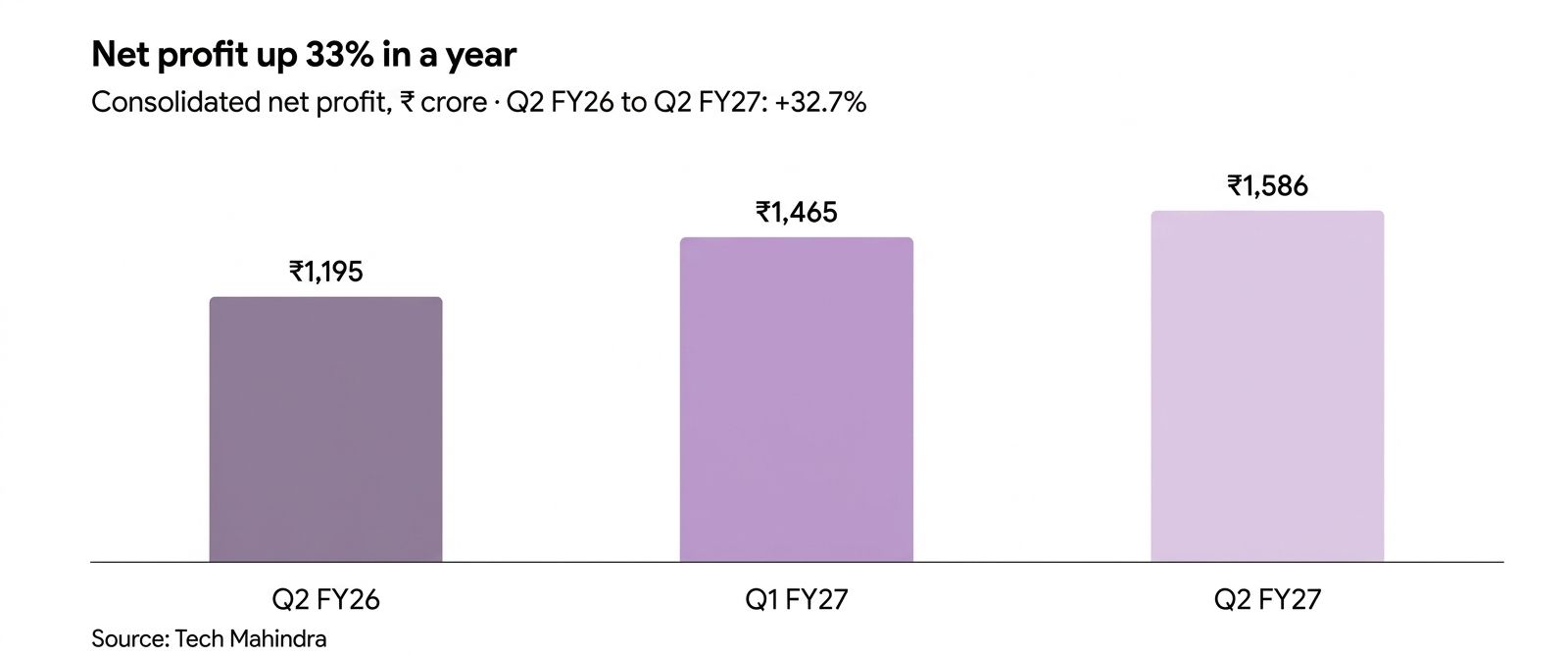
The company reported strong Q2FY27 numbers. Net profit surged 32.7% YoY to ₹1,586 crore, while revenue rose 15.6% YoY to ₹16,180 crore.
Tech Mahindra shares rallied 8.48% to ₹1,790, on Friday, October 16, 2026, following the earnings and bonus news.
- The bonus record date is not announced yet. The company expects to credit bonus shares by December 15, 2026, subject to approvals.
Introduction
On Thursday, October 15, 2026, Tech Mahindra announced its September-quarter (Q2 FY27) results after market hours. And it came with a double treat for shareholders: a ₹15 interim dividend and a proposed 1:1 bonus issue.
Did you know that Tech Mahindra has announced its first bonus issue since March 2015? Tech Mahindra is an Indian multinational IT services and digital consulting company headquartered in Pune with operations in over 90 countries.
The company reported its Q2 FY27 financial results on October 15, 2026 after market hours. Its consolidated net profit jumped 32.7% year-on-year to ₹1,586 crores and its consolidated revenue increased by ₹16,180 crores in this period. The record date of the bonus issue is yet-to-be-announced. The company also declared an interim dividend of ₹15 per share with a record date of October 23, 2026.
The company is celebrating its 40th anniversary this quarter, and the bonus plus dividend comes as part of that milestone.
But before you get excited about "free shares", let's first look at its financial performance at a glance and thereafter understand what a bonus issue actually does to your money.
Spoiler: your wealth doesn't double. Let's see why.
At a Glance: Q2 FY27 Performance
What is a bonus issue & how does 1:1 bonus work?
A bonus issue is when a company gives free extra shares to its existing shareholders, in proportion to what they already own. You don't pay anything for them.
The ratio tells you how many you get:
- 1:1 bonus → 1 free share for every 1 share you hold.
- 1:2 bonus → 1 free share for every 2 shares you hold.
So does this mean my investment value increases after bonus shares? No. A common misconception is that bonus shares double {or increase} your overall investment wealth overnight. In reality, the total value of your holding stays the same because when the number of shares doubles, the share price adjusts to roughly half at the same time.
Are bonus shares free? Not really. While you don’t pay money for bonus shares you don’t get any extra value.
Let’s understand this with Tech Mahindra’s example.
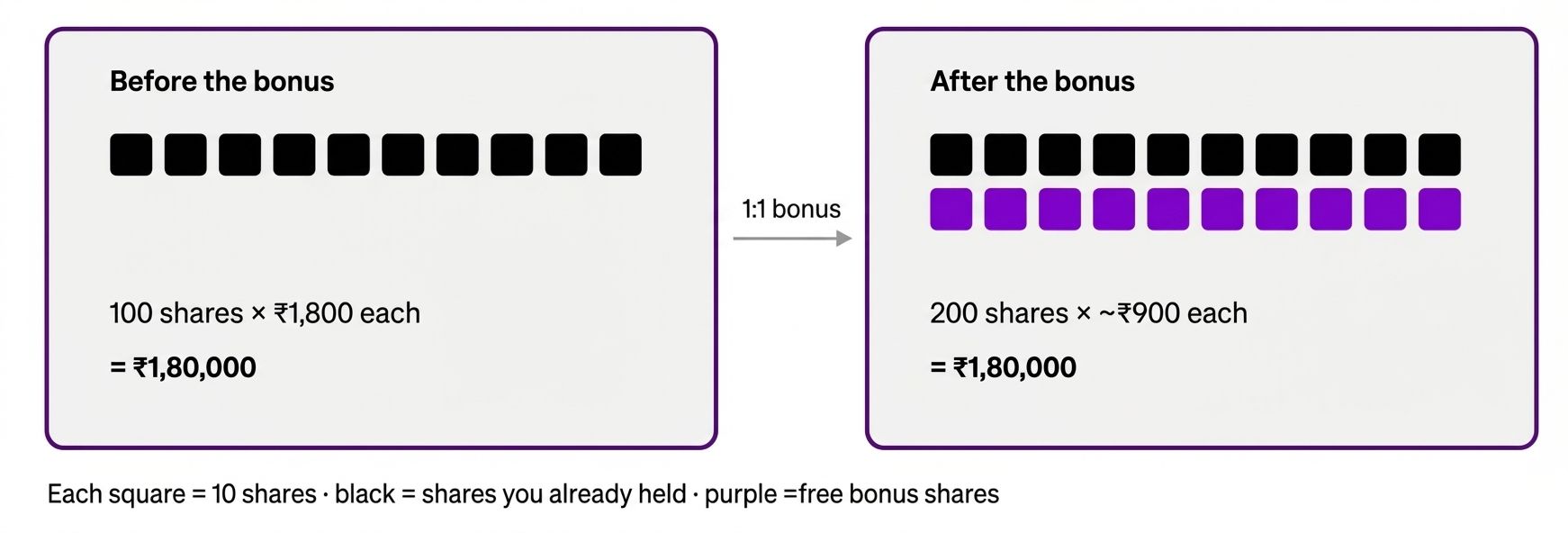
Say you own 100 Tech Mahindra shares, and the stock trades at ₹1,800 (an assumed price, for easy maths). Now the company has announced a 1:1 bonus issue.
So you receive 100 extra shares, and your total holding is 200 shares. But although you now own twice the number of shares, each is worth half as much. Hence, your wealth is unchanged, and so is your percentage ownership in the company.
Think of it like a pizza. Cut it into 8 slices instead of 4, and you have more slices. But you still have the same amount of pizza. A bonus issue simply cuts the company into more slices.
Tech Mahindra's Bonus & Dividend: The Key Details
Here's everything announced on October 15, in one place.

Record date vs ex-date: what's the difference?
These two dates decide your eligibility to receive bonus shares or dividend. They might sound similar, but they are not. So let's understand the difference.
Record date: The cut-off date when the company checks its list of shareholders. If your name is on the list that day, you get the benefit.
- Ex-date: The day the stock starts trading without the benefit. If you buy on or after the ex-date, you don't get the bonus (or dividend).
India follows T+1 settlement. This means shares you buy reach your demat account one trading day later. So the ex-date is usually the same day as the record date, and you must buy at least one trading day before the record date.
For the dividend, that means buying by Thursday, October 22, 2026. For the bonus, we'll know the cut-off once Tech Mahindra announces the record date.
What changes after the bonus?
Per-share numbers get halved. Earnings per share (EPS) and future dividends per share will look smaller, because the same profit is split across twice the shares. Nothing has actually shrunk.
F&O contracts are adjusted. Tech Mahindra trades in Futures & Options. On the ex-date, the exchange adjusts strike prices and lot sizes so that open positions keep the same value.
- Tax: your bonus shares have zero cost. For capital gains tax, the purchase cost of bonus shares is taken as nil. Your holding period starts from the date they're allotted. Check with your tax advisor before selling.
Why is Tech Mahindra giving bonus shares?
Many companies issue bonus shares to lower their share prices and make them affordable to small investors. For example, if Tech Mahindra share price reduces from ₹1,800 to around ₹900 after the bonus issue then more people may be able to afford its shares.
Issuing bonus shares increases liquidity as the total number of shares available for trading goes up. It becomes easier to buy and sell shares of the company.
- If a company announces bonus shares it could signal solid accumulated profits (reserves) and the confidence of the company’s management in its growth prospects.
To sum up
After 15 years, Tech Mahindra has announced a 1:1 bonus issue subject to shareholders’ approval. Existing long-term shareholders gain an immediate cash distribution via the ₹15 interim dividend. The dual announcement reflects Tech Mahindra's focus on capital return while lowering price barriers for smaller market participants.
However, you should know that a bonus issue doesn't make you richer on day one. You get more shares, but the price adjusts. Your total value stays the same. Thus it's important that you don't buy its shares just for the bonus.
Buying a stock only to "get free shares" makes little sense. You should check the company’s fundamentals: growth, margins, valuation and deal pipeline, and understand its bonus issue before investing.
FAQs
What is the record date of Tech Mahindra bonus issue?
The company has not yet announced the record date of the bonus issue. Keep an eye on our blog and ArihantPlus mobile app notifications to get the information as soon as it's announced.
Do bonus shares mean better returns for Tech Mahindra investors?
Not necessarily. However, usually when people find the shares affordable and have faith in the company’s growth prospects they may buy more shares of the company. This could push up its share price and eventually you could get higher returns.
Will the bonus shares get the ₹15 dividend?
No. The dividend record date (October 23) comes well before the bonus shares are issued. So the ₹15 dividend is paid only on the shares you hold today.
Why is the board raising "authorised share capital"?
Authorised share capital is the maximum amount of shares a company is allowed to issue. A 1:1 bonus doubles Tech Mahindra's share count, which would cross its current limit.
So the board has proposed raising this limit from ₹924.3 crore to ₹1,000 crore. This also needs shareholder approval, along with the bonus.
Related Topics

Muhurat Trading 2026: NSE Announces Timings & Date for Stock Markets

RBI Repo Rate Hike October 2026: 10 Takeaways That Matter for Your Money





NSE Pre-Open Session Rules Have Changed: Here’s What Traders Need to Know

LIC Gets RBI Nod for 9.99% HDFC Bank Stake: Buy Signal or Market Noise?

India’s July Factory Growth Hits a 5-Year Low. Should We Be Worried?

Closing Auction Session (CAS) kicks in from 3rd August: Market timing changes

Ethical Investing Gets Real: NSE and BSE Launch Saatvik and Ahimsa Indices


Can REITs and InvITs Become India’s Next Retail Portfolio Essential?

Everyone Knows Bajaj Finance’s Playbook. So Why Can’t Anyone Copy It?


Beyond the Dark Store: Is Advertising Zepto's Real Business?

Vedanta Demerger: Why Aluminium Became the Market’s Favourite/Darling


NSE Extends F&O Market Close to 3:40 PM: What Traders Must Know

Elon Musk’s $119 Billion Terafab Bet: Can It Reshape AI Chips?

Rupee Crashes to ₹96: How Investors Can Profit From the Fall

The Rise of India’s Defence Sector: Stocks, Trends & Opportunities

SEBI introduces Verified Badge for Trading Apps to Curb Fake App Scams

TCS Q4 Concall: AI Infrastructure to Drive the Next Growth Cycle

Rupee Slips Past 95/USD | Factors Driving the Fall Despite RBI Intervention


The Popcorn Trade: How Dhurandhar 2 is driving PVR INOX Stock Higher

Oil Is Surging After The Iran Strikes. So Why Isn’t Gold Following?

What’s Getting Cheaper & Costlier in Budget 2026: A Simple Money Guide


Union Budget Day & Market Behaviour: 15 Year Trend Analysis (2011-2025)

Maruti Q3FY26 Profit Up 4%: Losing Grip on India’s Car Market?


New Year, New Financial Goals: Make SIP Your 2026 Resolution

Infosys ₹18,000 Crore Share Buyback: Record Date & Why Promoters Opted Out?

Nifty 50 Performance Since Last Muhurat Trading: Nifty Top 10 Performers

Diwali Muhurat Trading: Can Nifty’s 7-Year Winning Streak Continue?


Tata Motors Demerger Gets NCLT Nod: What Shareholders Must Know

Muhurat Trading 2025 on 21 Oct: Everything You Should Know


Tuesday is the New Thursday: NSE & BSE Expiry Shift from Sep 2025


How Jane Street Snatched ₹36,500 Crore While India's Youth Lost Everything

Axis Bank Q1FY26 Results: A Mixed Bag, but Long-Term Picture Still Intact

Indian Stock Market Outlook: What Happened And Way Forward